
Scientific papers
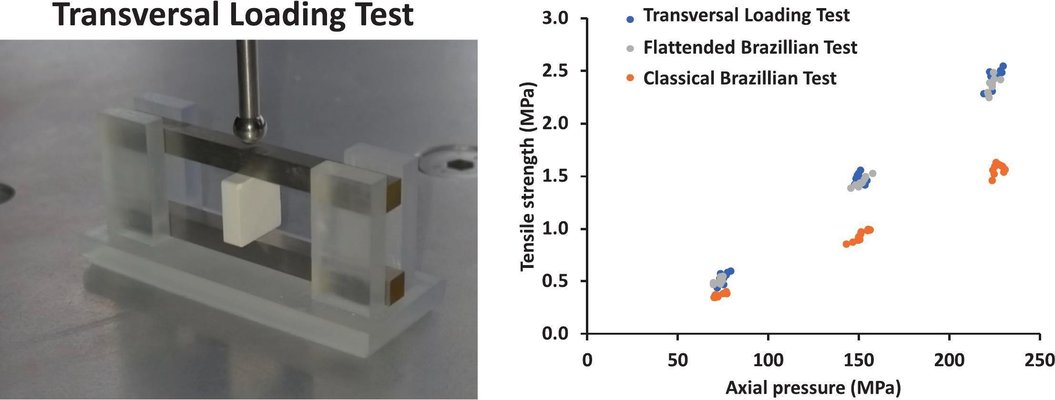
Understanding the true mechanical strength of pharmaceutical tablets is essential, yet traditional tensile strength measurements can be misleading. The widely used classical Brazilian test (CBT)—performed on thin cylindrical discs—often produces inaccurate results because of imperfect contact between the compact and loading surfaces. To address these limitations, alternative methods such as the transversal compression test (TCT) and the flattened Brazilian test (FBT) have been introduced, using different compact geometries to improve reliability.
In this study, we combined finite element simulations with experimental evaluation to compare these testing approaches for brittle excipients. The simulations indicate that TCT and FBT generate similar stress profiles, suggesting they should yield comparable tensile strength values. Experimental data on lactose and mannitol confirm this: tabletability curves derived from TCT and FBT match closely and both consistently exceed those obtained with CBT. These findings demonstrate that CBT underestimates tensile strength for brittle materials and that values from CBT and TCT should not be used interchangeably.
Comments
No comments posted yet.
Add a comment
Articles you may like
Related products


Looking for additional information?
Let us help you