
Scientific papers
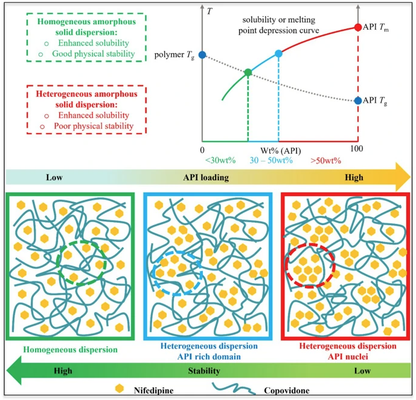
Synthetic polymers play an important role in pharmaceutical formulations by enabling controlled drug release, improving bioavailability, and enhancing stability. Copovidone is widely used as an excipient in hot-melt extrusion (HME) to improve the solubility of poorly water-soluble active pharmaceutical ingredients (APIs). However, developing stable amorphous polymer/API systems presents two key challenges: determining the optimal copovidone/API ratio based on the solubility of the crystalline API in the polymer matrix, and ensuring adequate long-term physical stability of the amorphous API. In this study, Plasdone™ S630 Ultra copovidone was used to solubilize the poorly water-soluble API nifedipine. Copovidone/nifedipine extrudates with drug loadings ranging from 10 to 60% w/w were produced by HME at temperatures above the melting point of nifedipine. Differential scanning calorimetry (DSC) and X-ray diffraction (XRD) confirmed the formation of amorphous systems at all drug loadings, including 60% w/w, as evidenced by a single glass transition temperature and broad diffraction patterns. Extrudate homogeneity and stability were subsequently assessed using rheological heat-cool temperature cycles. Low drug loadings showed homogeneous structures and consistent rheological behaviour, while medium drug loadings exhibited slight deviations indicative of API-rich regions. At high drug loadings, pronounced changes in rheological properties suggested the dynamic formation of API nuclei. Although all formulations provided improved solubility compared with crystalline nifedipine, higher drug loadings showed reduced physical stability, with API recrystallization observed under accelerated storage conditions. Overall, this rheological approach enables formulation scientists to identify the optimal polymer/API composition by establishing a semi-phase diagram and, combined with subsequent stability testing, demonstrates the importance of accurately determining API solubility within the polymer matrix to achieve a thermodynamically stable amorphous formulation.
Comments
No comments posted yet.
Add a comment
Articles you may like

Related products




Looking for additional information?
Let us help you