
Scientific papers
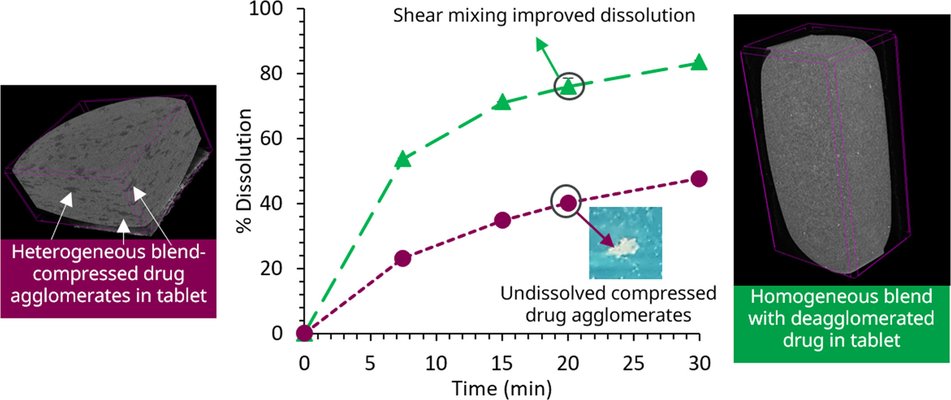
Dissolution testing plays a critical role in assessing the rate and extent of drug release to support the prediction of in vivo bioavailability. In this case study, an immediate-release tablet formulation containing an investigational BCS Class II compound demonstrated slow and incomplete dissolution at pH 4.5 and 6.8, raising concerns regarding potential reductions in drug exposure among patients with elevated gastric pH. To identify and address the underlying cause, three formulation and process-related variables were investigated: (1) drug substance particle size, comparing milled and unmilled material; (2) formulation wettability through the incorporation of a surfactant in combination with either water-soluble or water-insoluble fillers; and (3) shear mixing of the powder blend. Dissolution performance was found to be similar for tablets prepared with either milled or unmilled drug substance, while surfactant addition provided no measurable improvement. Further analysis revealed drug agglomeration as the primary factor limiting dissolution. The implementation of a simple shear-based deagglomeration step during pre-blending significantly improved dissolution behavior. This process modification enabled the original clinical formulation to be maintained, thereby eliminating the need for reformulation and avoiding associated development delays.
Comments
No comments posted yet.
Add a comment
Articles you may like

Related products


Looking for additional information?
Let us help you