
Scientific papers
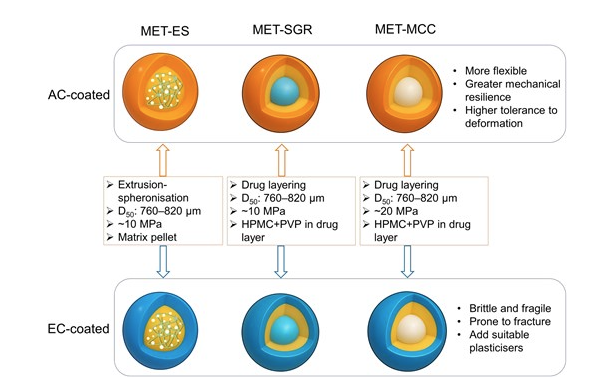
This study investigates the effects of compaction pressure, coating polymer, pellet core, and spatial arrangement on drug release from multiple-unit pellet system (MUPS) tablets. Drug-loaded cores were prepared by extrusion-spheronization or drug layering onto sugar and microcrystalline cellulose (MCC) nonpareils, followed by coating with a sustained-release layer of acrylic polymer (AC) or ethyl cellulose (EC). Coated pellets were manually arranged in separated or conjoint configurations, using MCC as a cushioning filler, and compacted into MUPS tablets at three compaction pressures with a compaction simulator. Dissolution testing was performed to assess drug release behaviour. Higher compaction pressures and the use of the more brittle EC coating resulted in faster drug release, while directly contacting pellets were more susceptible to coating damage due to direct stress transmission. In contrast, separated pellets benefited from being fully surrounded by the cushioning filler, which helped mitigate coating damage. Differences in drug release behaviour were also observed between pellet cores, reflecting their inherent properties. These findings demonstrate that pellet core, coating polymer, and spatial arrangement, together with the pellet-to-filler ratio, are important factors to consider when developing sustained-release MUPS tablets with targeted drug release profiles and robust performance after compaction.
Comments
No comments posted yet.
Add a comment
Articles you may like

Related products


Looking for additional information?
Let us help you