
Scientific papers
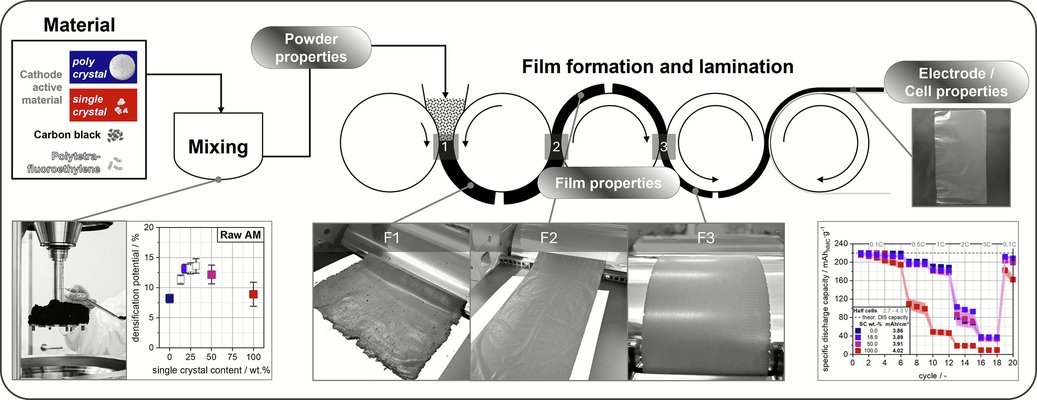
This research explores the impact of incorporating fine single crystal (SC) particles as cathode active material (CAM) blended with polycrystal (PC) CAM particles on PTFE fibrillation, processing, and overall performance in thin, dry-coated nickel-rich cathodes (~60 μm thickness, 3.9 mAh/cm², 1.5 wt% PTFE). Electrodes made solely from SC powders display higher bulk porosity and require greater mixing energy (~300 kJ/kg), leading to functional but inadequately fibrillated structures. Theoretical analysis suggests that including around 18.9 wt% SC in the PC blend effectively fills voids during compaction, producing denser electrodes with improved PTFE fibrillation and a more uniform microstructure. Measurements of powder flow reveal a relationship between wall-friction angles and film thickness at the initial coating stage. Subsequent calendering further enhances PTFE fibril structure, boosts the tensile strength of standalone films, and reduces electrode electrical resistivity, likely by freeing embedded carbon black within the PTFE matrix. Within the studied range, electrodes containing the optimal SC/PC ratio achieve a balanced combination of mechanical and electrical properties, delivering peak energy density (~2200 Wh/L at 0.1C). These results offer valuable insights for optimizing SC/PC blends and processing conditions in advanced dry-coated nickel-rich cathode manufacturing.
Comments
No comments posted yet.
Add a comment
Articles you may like
Related products


Looking for additional information?
Let us help you