
Scientific papers
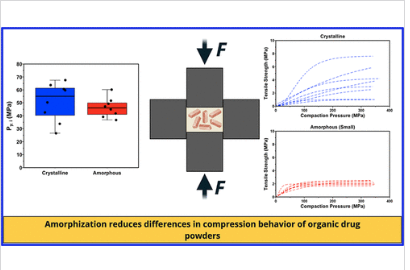
A clear understanding of the differences in compression behavior between amorphous and crystalline forms of organic pharmaceutical compounds is essential for assessing the impact of amorphization on tabletability and for enabling rational tablet formulation. In this study, the compaction behavior of both solid-state forms was examined using a set of structurally diverse model drugs. The results show that amorphous materials exhibit tabletability profiles that fall within a comparatively narrow range, whereas crystalline forms display greater variability. At elevated compaction pressures, the observed differences in tabletability are largely attributed to variations in interparticulate bonding strength, a finding supported by infrared spectroscopic analysis. The implications of these results for the formulation and development of amorphous solid dispersions in tablet dosage forms are also discussed.
Comments
No comments posted yet.
Add a comment
Articles you may like
Related products






Looking for additional information?
Let us help you