
Scientific papers
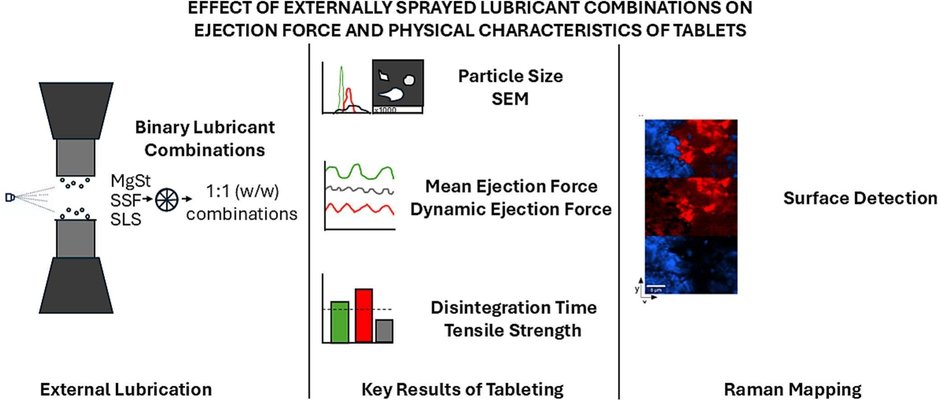
Lubricants play a critical role in tablet ejection, yet the internal use of magnesium stearate (MgSt) is known to negatively affect tablet tensile strength and disintegration. This study investigated an alternative external lubrication strategy based on binary 1:1 (w/w) lubricant mixtures to reduce MgSt content. Sodium stearyl fumarate (SSF) and ground sodium lauryl sulfate (SLS)—used externally for the first time—were applied individually and in combination during compression (5–10 kN).
Ejection force (EF) and dynamic EF profiles were measured across 100 tablets. Among the individual lubricants, SSF generated the lowest EF, whereas SLS resulted in the highest EF and the greatest variability. Binary mixtures showed EF values comparable to, and in some cases lower than, those of single lubricants, indicating that MgSt levels can be reduced by half without compromising lubrication performance.
Dynamic EF analysis highlighted force-dependent behaviors: hydrophobic MgSt systems exhibited greater stability at higher compression forces, likely due to improved film formation, while hydrophilic lubricants performed more consistently at lower forces but became less stable as force increased. Variability in EF profiles was attributed to factors such as inconsistent SLS spraying—linked to irregular particle surface area—or instability in mixed hydrophobic–hydrophilic lubricant layers.
Tablet performance was also influenced by lubricant type, with SSF and SLS formulations outperforming MgSt by preserving mechanical strength while maintaining effective disintegration. Raman mapping confirmed the presence of lubricants on tablet surfaces. Overall, these results demonstrate that binary external lubrication is a promising approach to reducing MgSt-related mechanical limitations while ensuring efficient tablet ejection.
Comments
No comments posted yet.
Add a comment
Articles you may like

Related products


Looking for additional information?
Let us help you